


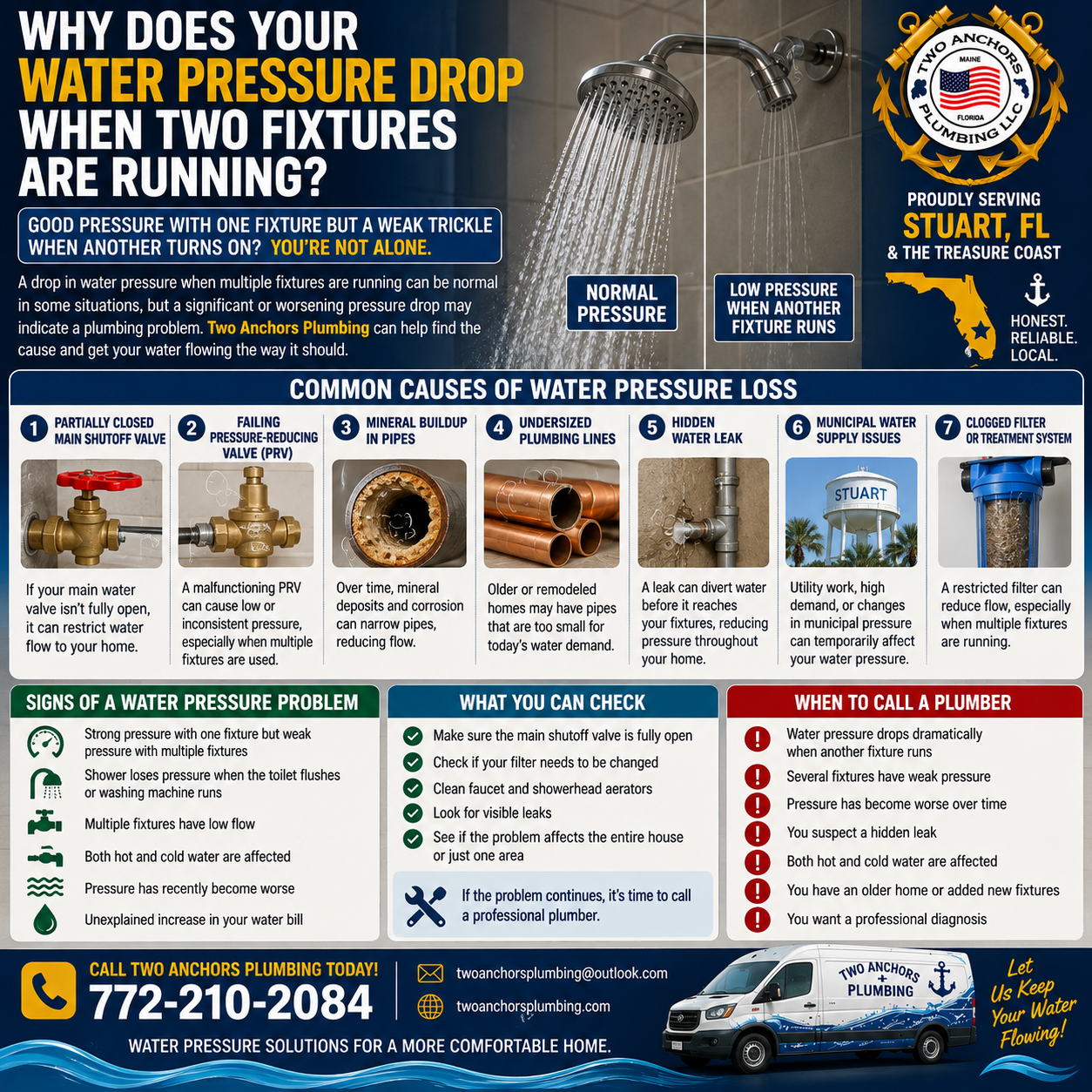
Why Does Your Water Pressure Drop When Two Fixtures Are Running?
You turn on the shower and everything seems fine—until someone starts the washing machine, flushes a toilet, or turns on the kitchen faucet. Suddenly, your strong shower becomes a weak trickle.
A small change in water pressure when several fixtures operate at once can be normal, but a dramatic or worsening pressure drop may indicate a problem somewhere in your home’s plumbing system.
For homeowners in Stuart, FL, identifying the cause can improve everyday water performance while uncovering plumbing problems that might otherwise go unnoticed.
At Two Anchors Plumbing, we diagnose water-pressure and water-flow problems throughout Stuart and the Treasure Coast and help homeowners find the right solution.
Pressure vs. Flow: What’s the Difference?
Although they’re often used interchangeably, water pressure and water flow aren’t the same thing.
Water pressure is the force pushing water through your plumbing. Flow refers to how much water can actually move through the system during a given period.
A home may appear to have good pressure when only one fixture is operating but struggle to provide enough flow when several fixtures demand water simultaneously.
That distinction can provide an important clue when diagnosing the problem.
1. A Partially Closed Main Shutoff Valve
Your home’s main water valve needs to be fully open for unrestricted water flow.
If the valve was partially closed during previous plumbing work and never completely reopened, you might not notice a problem until multiple fixtures are operating.
This is one of the simpler possibilities to investigate.
2. A Failing Pressure-Reducing Valve
Some homes use a pressure-reducing valve (PRV) to regulate incoming municipal water pressure.
When a PRV begins malfunctioning, household pressure may become unusually low or inconsistent. The problem can become especially noticeable when several fixtures demand water simultaneously.
Because incorrect pressure can affect plumbing components throughout the home, proper testing is important before adjusting or replacing a PRV.
3. Mineral Buildup Inside the Plumbing
Over time, mineral deposits and corrosion can reduce the interior diameter of certain pipes and fittings.
Think of it like narrowing a highway: one car may pass easily, but traffic becomes a problem when demand increases.
Restricted plumbing may still supply enough water for one faucet while struggling when the shower, washing machine, and another fixture operate together.
4. An Undersized Plumbing Line
Pipe diameter affects how much water your plumbing can deliver.
In some homes—particularly those that have been remodeled or expanded—the original piping may not adequately serve the number of fixtures now connected to it.
A new bathroom, larger shower, additional appliances, or other modifications can expose limitations that weren’t noticeable with the home’s original configuration.
5. A Hidden Water Leak
A leak somewhere in the plumbing system can divert water before it reaches your fixtures.
Depending on its size and location, you may also notice:
- Unexplained increases in your water bill
- Damp walls or ceilings
- Water stains
- Musty odors
- The sound of running water when fixtures are off
- Unusually wet areas around the property
A significant unexplained pressure or flow change deserves investigation.
6. Problems With the Municipal Water Supply
Not every pressure problem originates inside your home.
Utility work, neighborhood demand, supply issues, or changes in municipal pressure can temporarily affect household water performance.
One useful clue is whether the problem affects both hot and cold water throughout the entire house.
If every fixture suddenly experiences the same problem, the incoming supply should be considered during diagnosis.
7. A Clogged Whole-House Filter or Treatment System
If your home has a whole-house filtration or water-treatment system, restricted filters can reduce flow throughout the property.
This can be particularly noticeable when multiple fixtures operate simultaneously.
Filter maintenance should follow the equipment manufacturer’s recommendations.
Why Does My Shower Lose Pressure When the Toilet Flushes?
A toilet’s fill valve demands water immediately after flushing.
If your plumbing system has limited available flow, that additional demand can temporarily reduce the amount of water reaching your shower.
A minor change may be expected in some systems. A major pressure drop every time someone flushes, however, is worth investigating—especially if the problem is new or becoming worse.
Why Does the Washing Machine Affect My Shower So Much?
Washing machines can draw a substantial amount of water during portions of their cycle.
If your home’s available flow is already restricted by a valve, aging piping, filtration system, or another issue, the washing machine can make the problem much more obvious.
The appliance isn’t necessarily causing the plumbing problem. It may simply be revealing an existing restriction.
Is Low Water Pressure Always a Plumbing Problem?
No.
That’s why professional diagnosis matters.
A plumber can evaluate the system under different flow conditions rather than assuming that replacing a faucet or showerhead will solve a whole-house problem.
Testing can help distinguish among:
Fixture problem → Branch-line problem → Whole-house plumbing problem → Incoming water-supply problem
Finding where the pressure loss begins is key to selecting the correct repair.
When Should You Call a Plumber?
Consider professional evaluation if:
- Your shower nearly stops when another fixture runs
- Water pressure has recently become worse
- Several fixtures have weak flow
- Both hot and cold water are affected
- Pressure fluctuates significantly
- You suspect a hidden leak
- Your home has older plumbing
- The problem affects everyday appliance use
Sudden, significant changes are particularly worth investigating.
How Two Anchors Plumbing Can Help
Two Anchors Plumbing can evaluate your home’s plumbing system and determine why water performance drops when demand increases.
Depending on the cause, our services can include:
✔ Water pressure testing
✔ Pressure-reducing valve diagnosis
✔ Shutoff valve inspection and repair
✔ Leak detection
✔ Plumbing supply-line evaluation
✔ Fixture and valve repairs
✔ Whole-home plumbing inspections
Instead of guessing which component is responsible, we’ll work to identify the source of the restriction.
Water Pressure Problems in Stuart, FL?
You shouldn’t have to schedule your shower around the washing machine.
If your home’s water pressure drops dramatically whenever another fixture is used, Two Anchors Plumbing can help determine what’s happening and recommend an appropriate solution.
Proudly serving Stuart, FL and the Treasure Coast.
📞 772-210-2084
📧 twoanchorsplumbing@outlook.com
🌐 twoanchorsplumbing.com
Comments are closed