


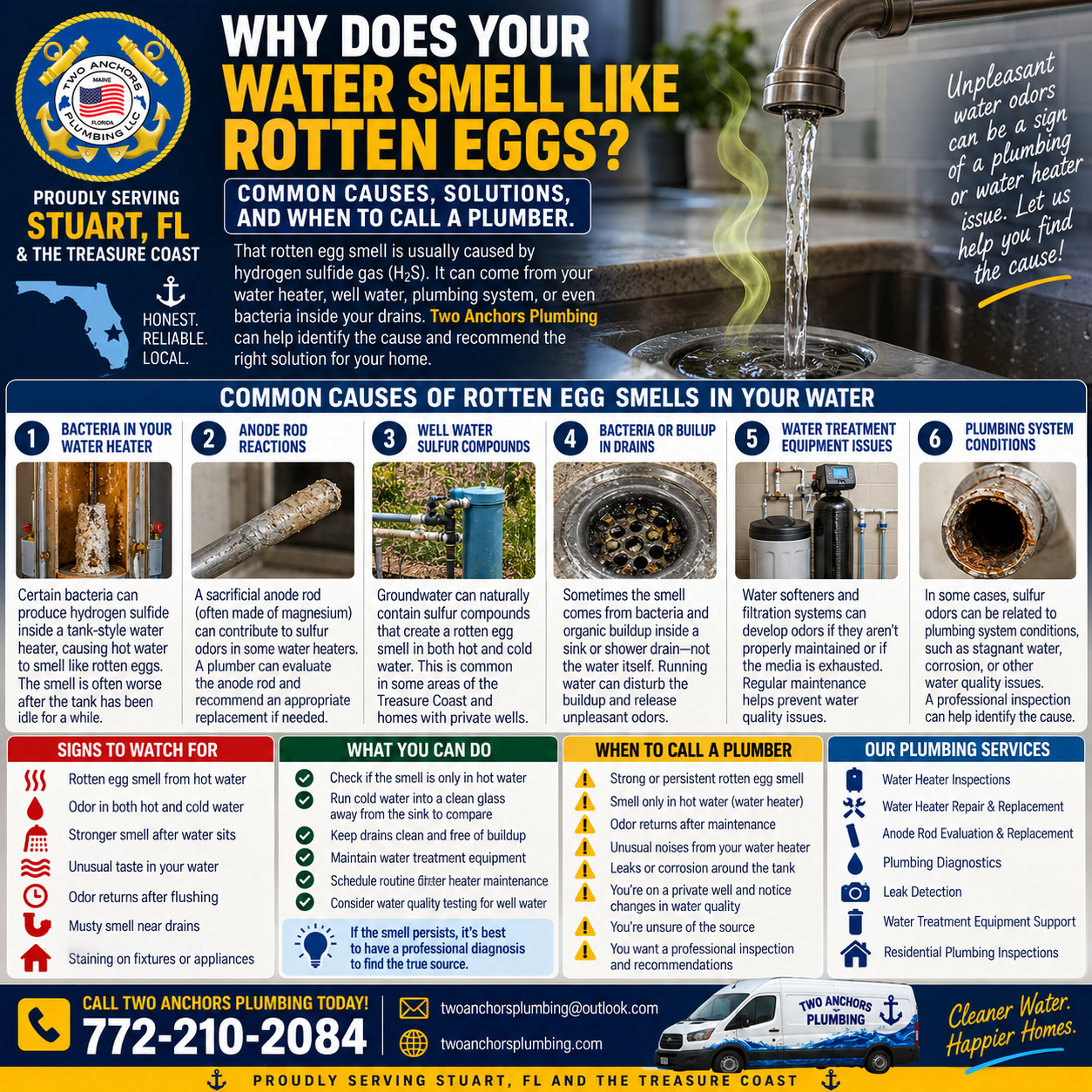
Why Does Your Water Smell Like Rotten Eggs? What South Florida Homeowners Need to Know
Have you ever turned on your kitchen or bathroom faucet and noticed an unpleasant smell resembling rotten eggs? It’s not exactly what you expect when washing your hands, taking a shower, or filling a glass of water.
While an occasional unusual odor might not seem concerning, water that consistently smells like rotten eggs can indicate a problem with your water heater, plumbing system, or water supply.
For homeowners in Stuart, FL, understanding the source of these odors is especially important because South Florida’s groundwater conditions, private wells, and water-heating systems can all contribute to water-quality concerns.
At Two Anchors Plumbing, we help homeowners throughout Stuart and the Treasure Coast diagnose plumbing and water-heater problems so they can find appropriate, lasting solutions.
What Causes Water to Smell Like Rotten Eggs?
The distinctive rotten-egg odor is commonly associated with hydrogen sulfide gas (H₂S).
Hydrogen sulfide can occur naturally in groundwater or develop through certain chemical and biological processes within plumbing and water-heating systems.
However, not every rotten-egg smell comes from the water itself. Sometimes, odors originating inside a drain can make perfectly normal water appear to smell unpleasant.
Identifying where the odor originates is the first step toward correcting the problem.
1. Bacteria Inside Your Water Heater
One potential cause of rotten-egg odors is bacterial activity inside a traditional tank-style water heater.
Certain bacteria can interact with sulfur compounds and conditions inside the tank, producing hydrogen sulfide.
You might notice:
- Rotten-egg odors when using hot water
- Stronger smells after the water heater has been idle
- Odors that seem worse at certain fixtures
- Unpleasant smells that return after temporarily disappearing
If the odor occurs exclusively when using hot water, the water heater is an important place to investigate.
2. Your Water Heater’s Anode Rod May Be Contributing
Most traditional tank-style water heaters contain a component called a sacrificial anode rod.
This rod helps protect the steel tank from corrosion by gradually deteriorating instead of the tank itself.
Under certain water conditions, reactions involving magnesium anode rods can contribute to hydrogen sulfide production.
In some cases, a plumber may recommend an alternative anode rod compatible with the water heater and local water conditions.
Important: Never remove an anode rod permanently without an appropriate manufacturer-approved solution. Doing so can accelerate tank corrosion and may affect warranty coverage.
3. Sulfur Compounds in Well Water
Some Treasure Coast properties rely on private wells rather than municipal water.
Groundwater can naturally contain sulfur compounds that produce unpleasant odors.
If you use well water, you may notice the smell in both hot and cold water.
Other possible symptoms include:
- Unusual water taste
- Discoloration
- Staining around plumbing fixtures
- Odors that vary in intensity
- Changes after periods of heavy water use
A professional water-quality test can help identify the actual cause and determine whether treatment is necessary.
4. Bacteria or Buildup Inside the Drain
Sometimes the water isn’t responsible at all.
Organic buildup inside a sink drain can produce odors that become more noticeable when running water disturbs the material.
Here’s a simple observation homeowners can make:
Fill a clean glass with cold water, move away from the sink, and carefully check whether the odor is coming from the water itself.
If the water smells normal away from the sink but the odor is noticeable near the drain, the drain may be responsible.
This isn’t a substitute for professional testing, but it can help narrow down the possibilities.
5. Problems With Water Treatment Equipment
Homes equipped with water softeners, filtration systems, or other water-treatment equipment may occasionally experience odor problems related to maintenance or system conditions.
Depending on the equipment, potential contributors include:
- Exhausted filtration media
- Improper maintenance
- Biological buildup
- Incorrect treatment settings
- Changes in incoming water quality
Water-treatment equipment should be inspected and maintained according to the manufacturer’s instructions.
Is Rotten-Egg-Smelling Water Dangerous?
A rotten-egg odor doesn’t automatically mean your water is unsafe, but smell alone cannot establish whether water is safe to drink.
Hydrogen sulfide is often noticeable at very low concentrations. However, unusual odors can also occur alongside other water-quality problems that require testing.
If your drinking water suddenly develops an unexplained odor, consider contacting your water utility or a qualified water-testing professional.
For private wells, appropriate laboratory testing is particularly important because homeowners are generally responsible for monitoring their own water quality.
If the odor is strong throughout the room, resembles a natural-gas leak, or cannot clearly be traced to the water, leave the area and contact your gas utility or emergency services from a safe location.
Why Does Only My Hot Water Smell?
This is one of the most useful clues when diagnosing sulfur odors.
If cold water smells normal but hot water has a persistent rotten-egg odor, the problem may involve the water heater.
Possible contributing factors include bacterial activity, anode rod reactions, and water chemistry.
A qualified plumber can evaluate the water heater and determine whether maintenance, component replacement, or additional testing is appropriate.
Can Flushing Your Water Heater Fix the Smell?
Sometimes water-heater maintenance helps, but flushing alone isn’t guaranteed to eliminate sulfur odors.
Flushing removes some accumulated sediment, while persistent hydrogen sulfide problems may require additional investigation.
Depending on the findings, a professional may recommend:
- Water-heater inspection
- Sediment removal
- Anode rod evaluation
- Manufacturer-approved tank treatment
- Water-quality testing
- Water-treatment recommendations
The appropriate solution depends on the actual source of the odor.
How Can South Florida Homeowners Prevent Water Odors?
Preventive maintenance can reduce the likelihood of certain water-heater and plumbing problems.
Consider these steps:
Schedule regular water-heater inspections. A professional can evaluate the tank, components, and overall condition.
Maintain water-treatment equipment. Replace filters and service equipment according to manufacturer recommendations.
Test private well water. Regular testing can identify changes in water quality that may not be obvious from appearance or smell.
Pay attention to hot-versus-cold differences. This information can help identify whether the problem involves the water heater or incoming supply.
Address recurring odors promptly. Persistent problems deserve investigation rather than repeated temporary treatments.
When Should You Call a Professional Plumber?
Contact a plumber if:
- Your hot water consistently smells like rotten eggs.
- The odor returns after water-heater maintenance.
- Your water heater makes unusual noises or shows signs of deterioration.
- You notice leaks or corrosion around the water heater.
- Water pressure or temperature has become inconsistent.
- You’re unsure whether the smell originates in the plumbing or water heater.
If both hot and cold water are affected, water-quality testing or consultation with the water supplier may be the best first step.
How Two Anchors Plumbing Can Help
At Two Anchors Plumbing, we understand that unpleasant water odors can make everyday household activities frustrating.
When the problem involves plumbing or water-heating equipment, professional diagnosis can help identify the cause and prevent unnecessary repairs.
Our residential plumbing services include:
✔ Water-heater inspections ✔ Water-heater repair and replacement ✔ Anode rod evaluation ✔ Water-heater maintenance ✔ Plumbing inspections ✔ Leak detection and repair ✔ Residential plumbing diagnostics
Our goal is to help homeowners understand their plumbing problems and make informed decisions about repairs.
Water Heater and Plumbing Services in Stuart, FL
You shouldn’t have to tolerate unpleasant odors every time you turn on the hot water.
Whether the problem involves your water heater, plumbing components, or incoming water supply, identifying the source is essential to finding an effective solution.
Two Anchors Plumbing proudly provides residential plumbing services throughout Stuart, FL and the Treasure Coast.
Two Anchors Plumbing LLC
Your Local Stuart, Florida Plumbing Professionals
twoanchorsplumbing@outlook.com
Comments are closed