


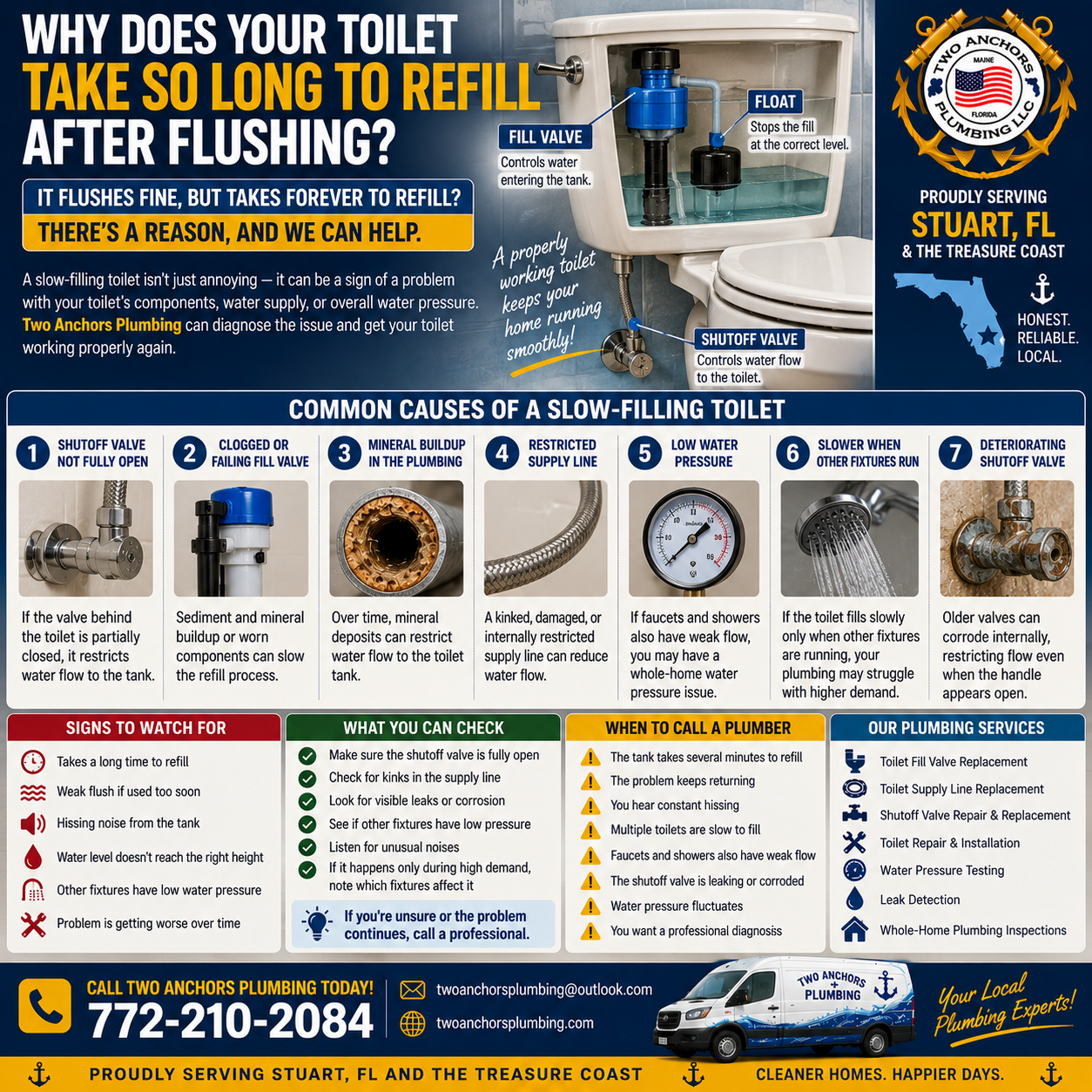
Why Does Your Toilet Take So Long to Refill After Flushing?
You flush the toilet, everything goes down normally, but then you hear the tank slowly filling for what seems like forever. A toilet that suddenly takes much longer than usual to refill isn’t just irritating—it can indicate a problem with the toilet’s water supply or internal components.
For homeowners in Stuart, FL, a slow-filling toilet is often relatively straightforward to repair. However, it can also provide an early clue about water-pressure or supply problems elsewhere in the home.
At Two Anchors Plumbing, we diagnose slow-filling toilets and other bathroom plumbing problems throughout Stuart and the Treasure Coast.
How Long Should a Toilet Take to Refill?
The exact refill time varies depending on the toilet, water pressure, and fill valve, but you shouldn’t normally be waiting several minutes for the tank to become ready for another flush.
If your toilet used to refill quickly and has gradually become slower, something has probably changed.
Before replacing the entire toilet, several common components should be investigated.
1. The Toilet Shutoff Valve Isn’t Fully Open
The small valve located on the wall or floor behind your toilet controls water entering the tank.
If it’s only partially open, the toilet may receive enough water to function but refill much more slowly.
This sometimes happens after plumbing work when the valve is closed and isn’t completely reopened afterward.
Older shutoff valves can also deteriorate internally and restrict flow even when the handle appears to be open.
2. The Fill Valve Is Clogged or Failing
The fill valve controls water entering the toilet tank after every flush.
As it ages, sediment or mineral deposits can restrict its internal passages. Components inside the valve can also wear out.
Possible symptoms include:
- Slow tank refill
- Hissing noises
- Inconsistent refill times
- Water that doesn’t shut off properly
- A toilet that occasionally continues running
In many cases, replacing a worn fill valve can restore normal operation.
3. Sediment or Mineral Buildup Is Restricting Water Flow
Small plumbing passages are particularly susceptible to sediment and mineral accumulation.
Over time, buildup can restrict the amount of water reaching the toilet tank.
If the problem developed gradually rather than overnight, mineral accumulation or a deteriorating component may be worth investigating.
4. The Toilet Supply Line Is Restricted
The flexible line running from the shutoff valve to the toilet can also create problems.
A supply line that’s kinked, deteriorated, damaged, or internally restricted may reduce water flow into the tank.
Supply lines should also be inspected periodically for corrosion, deterioration, and signs of leakage.
5. Your Home Has Low Water Pressure
Does the toilet fill slowly while faucets and showers also seem weaker than usual?
The problem may extend beyond the toilet.
Whole-home water-pressure or flow problems can result from several issues, including:
- A partially closed main valve
- Pressure-regulating equipment
- Restricted plumbing
- Water-treatment equipment
- A leak
- Incoming municipal supply conditions
If multiple fixtures are affected, treating the toilet alone may not solve the actual problem.
6. The Problem Only Happens When Other Fixtures Are Running
Pay attention to timing.
If the toilet normally refills quickly but slows dramatically when someone showers or the washing machine is running, the issue may involve the amount of water available when several fixtures demand it simultaneously.
That’s different from a toilet that fills slowly all the time.
This information can help a plumber determine whether the problem is at the toilet or elsewhere in the plumbing system.
7. The Shutoff Valve May Be Deteriorating
Older fixture shutoff valves don’t last forever.
Internal corrosion or deterioration can restrict flow, and attempting to force an old valve can sometimes create a leak.
If the valve is heavily corroded, difficult to operate, or already showing moisture, having it professionally evaluated is safer than repeatedly forcing the handle.
One Slow Toilet or Every Toilet?
This is an important diagnostic clue.
Only one toilet fills slowly:
The fill valve, fixture shutoff, or toilet supply line is more likely to be involved.
Several toilets fill slowly:
A broader water-supply problem should be considered.
The toilet and faucets are all weak:
The issue may involve whole-home water pressure or flow.
The toilet only fills slowly when other fixtures operate:
Your plumbing may be struggling when water demand increases.
The pattern matters.
Can a Slow-Filling Toilet Affect Flushing?
Yes, but not always in the way people expect.
The tank needs to reach its intended water level to provide the flush performance the toilet was designed for. If the tank hasn’t completely refilled before someone flushes again, the next flush may be weaker.
This can be especially noticeable in busy households where the toilet is used repeatedly within a short period.
Should You Replace the Whole Toilet?
Usually, not just because it fills slowly.
If the toilet itself is in good condition, replacing a fill valve, supply line, or shutoff valve may be all that’s necessary.
Replacement becomes more reasonable when the toilet has multiple recurring problems, damaged porcelain, inefficient performance, unavailable parts, or other age-related issues.
A proper diagnosis can help you avoid replacing a fixture unnecessarily.
When Should You Call a Plumber?
Consider professional service if:
- The tank takes several minutes to refill
- The problem is getting progressively worse
- The fill valve continuously hisses
- The shutoff valve is corroded or leaking
- Multiple toilets have become slow
- Faucets and showers also have weak flow
- Water pressure fluctuates
- The toilet doesn’t consistently refill to the proper level
If the symptom suddenly affects several fixtures at once, the issue deserves particular attention.
How Two Anchors Plumbing Can Help
Two Anchors Plumbing can determine whether your slow-filling toilet has a simple fixture problem or is revealing a larger water-supply issue.
Our services include:
✔ Toilet fill valve replacement
✔ Toilet supply-line replacement
✔ Shutoff valve repair and replacement
✔ Toilet repair and installation
✔ Water-pressure testing
✔ Leak detection
✔ Whole-home plumbing inspections
We diagnose the cause before recommending the repair.
Toilet Repair in Stuart, FL
You shouldn’t have to wait several minutes for your toilet to be ready for the next flush.
If your toilet has started filling slowly, Two Anchors Plumbing can identify the restriction and help restore proper water flow.
Proudly serving Stuart, FL and the Treasure Coast with dependable residential plumbing services.
📞 772-210-2084
📧 twoanchorsplumbing@outlook.com
🌐 twoanchorsplumbing.com
Comments are closed