


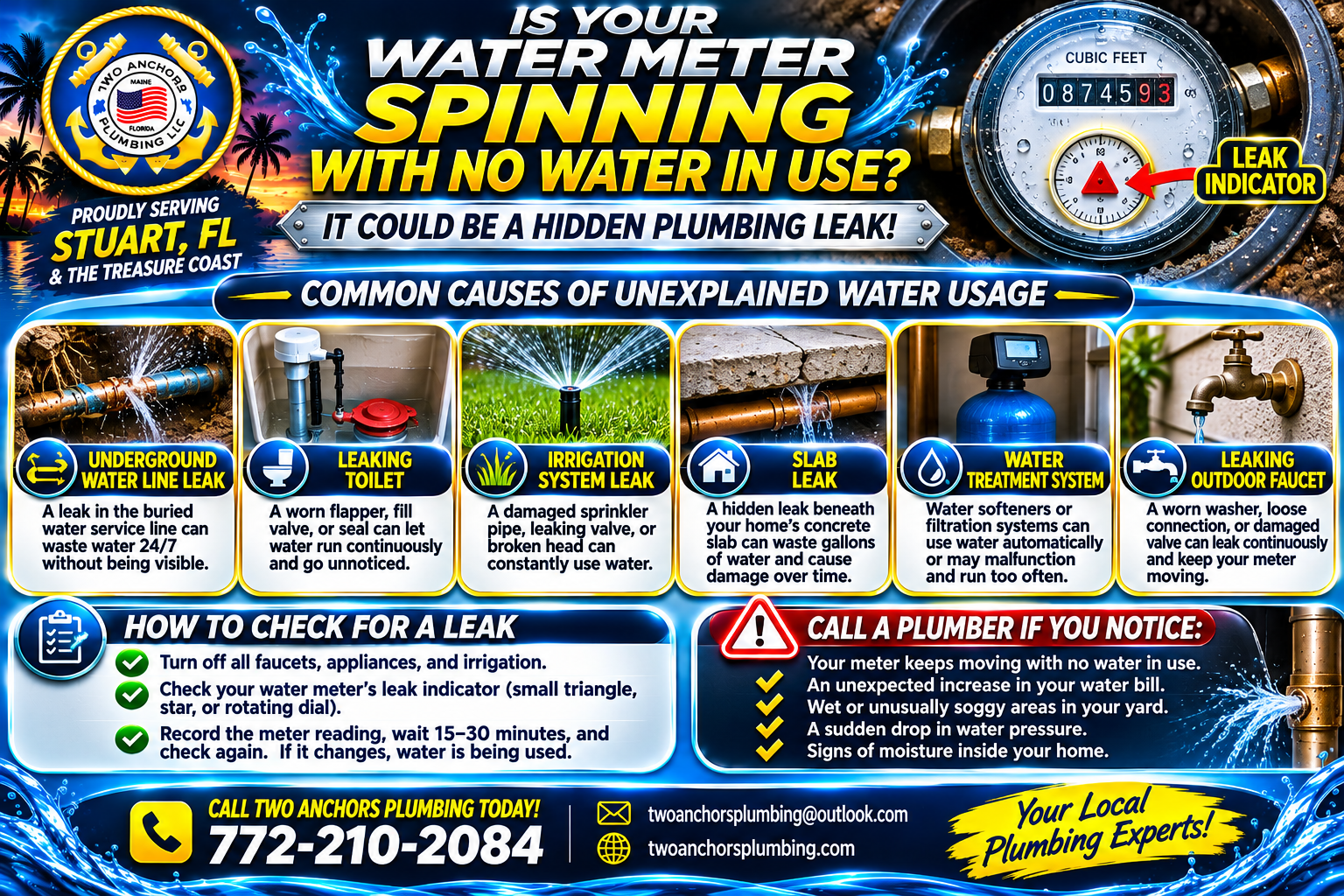
Why Is Your Water Meter Spinning When Nobody Is Using Water?
Have you ever looked at your water meter and noticed that it’s moving even though nobody in your home is using water?
Maybe every faucet is turned off, the washing machine isn’t running, and nobody has flushed a toilet. Yet the small indicator on your water meter continues to move.
That could be an early warning sign of a hidden plumbing leak.
For homeowners in Stuart, Florida, and throughout the Treasure Coast, understanding what your water meter is telling you can help identify water loss before it leads to expensive utility bills or property damage.
At Two Anchors Plumbing, we help homeowners diagnose hidden water leaks and identify plumbing problems that aren’t always visible.
1. What Does a Moving Water Meter Mean?
Your home’s water meter measures the amount of water passing through your water service connection.
Many meters have a small leak-detection indicator, often shaped like a triangle, star, or rotating dial. Digital meters may display flow information instead.
When water is being used, the meter records that usage.
If the meter continues registering flow while all water-using fixtures and appliances are off, water may still be moving through the plumbing system.
However, movement doesn’t automatically mean there’s a broken pipe. Automatic irrigation, water treatment equipment, toilet leaks, and other devices can also use water without someone actively turning on a faucet.
2. A Hidden Underground Water Line Leak
One possible cause of unexplained meter movement is a leak in the underground water service line.
This is the pipe that carries water from the utility connection toward your home’s plumbing system.
Depending on the property, the line may run beneath landscaped areas, driveways, sidewalks, or other outdoor surfaces.
Over time, underground water lines can develop leaks due to corrosion, ground movement, aging materials, damaged connections, or accidental excavation.
Warning signs of an underground leak
- Water meter movement when no water is intentionally being used
- Unusually wet areas of the yard
- Soft or muddy ground during dry weather
- Unexpected increases in water bills
- Reduced water pressure
- Water collecting near the foundation
Not every underground leak produces visible surface moisture, especially in sandy soil.
Professional leak detection can help locate the problem without unnecessary excavation.
3. A Toilet That Is Leaking Silently
A toilet can waste water without making much noise.
When a flapper, flush valve seal, or fill valve fails, water may move continuously or intermittently from the tank into the bowl.
Because the water goes directly into the drain, you may never see a puddle.
A simple way to check for a tank-to-bowl leak is to add a few drops of food coloring to the toilet tank, wait approximately 10–15 minutes without flushing, and see whether the color appears in the bowl.
If it does, the toilet is leaking internally.
Even a small toilet leak can cause your water meter to register unexpected usage.
4. An Irrigation System Leak
South Florida homeowners frequently rely on irrigation systems to maintain lawns, tropical landscaping, and outdoor plants.
An irrigation system connected to the home’s metered water supply can contribute to unexplained water usage.
Potential problems include damaged underground sprinkler pipes, leaking irrigation valves, broken sprinkler heads, and controllers operating at unexpected times.
Some irrigation systems use a separate meter or independent water source, so it’s important to determine how your particular system is supplied.
If your meter moves while the irrigation system is supposedly off, a leaking irrigation valve or underground connection may be responsible.
5. A Leak Beneath Your Concrete Slab
Many Florida homes are constructed on concrete slab foundations.
Water supply piping may run beneath or through the slab, depending on the home’s design.
If a concealed pipe develops a leak, water may escape without being immediately visible.
Possible warning signs include:
- Unexplained water meter activity
- Warm areas on the floor when a hot-water line is leaking
- Damp flooring or baseboards
- Unusual moisture near interior walls
- Persistent sounds of running water
- Increased water bills
These symptoms don’t prove a slab leak, but they justify further investigation.
A plumber can evaluate the plumbing system and determine whether specialized leak detection is appropriate.
6. A Water Softener or Filtration System Using Water
Some water treatment systems periodically use water for regeneration, backwashing, or other maintenance cycles.
If one of these systems operates automatically, the meter may register flow even when nobody is using a faucet.
A malfunctioning control valve can also cause some systems to discharge water unexpectedly or excessively.
If you have water treatment equipment, review its operating schedule and check whether the system is actively cycling.
Follow the manufacturer’s instructions before adjusting or bypassing equipment.
7. A Leaking Outdoor Faucet or Hose Connection
Outdoor faucets can develop slow leaks that are easy to overlook.
A worn washer, damaged valve, loose hose connection, or deteriorating pipe fitting may allow water to escape.
Leaks can be particularly difficult to notice when the faucet is located behind landscaping or connected to a long garden hose.
Inspect outdoor faucets, hose connections, and surrounding areas for moisture.
If you find a persistent leak, correcting it may resolve unexplained water usage.
How to Check Your Water Meter for a Possible Leak
You can perform a basic water meter test without specialized equipment.
Step 1: Turn Off All Water-Using Fixtures
Make sure faucets, showers, washing machines, dishwashers, and other water-using appliances are not operating.
Check whether irrigation or water treatment equipment is scheduled to run.
Step 2: Locate Your Water Meter
In many Florida neighborhoods, water meters are located in ground-level utility boxes near the street or property boundary.
The exact location varies by utility and property.
Open only the accessible meter-box lid if it is safe to do so. Avoid disturbing utility-owned equipment.
Step 3: Check the Leak Indicator
Look for a small rotating triangle, star, dial, or digital flow reading.
If the indicator moves while everything is off, the meter may be detecting water flow.
Step 4: Record the Reading
Take a photo of the meter or write down its reading.
Avoid using water for approximately 15–30 minutes, then check again.
If the reading increases, water has passed through the meter during that period.
Intermittent leaks may require a longer observation period.
Step 5: Isolate the House Plumbing if Appropriate
If you know where your home’s main shutoff valve is and can operate it safely, close it and observe the meter again.
If the meter stops, the water use may be occurring somewhere downstream of that shutoff valve.
If the meter continues registering flow, the problem may involve piping between the meter and the shutoff valve, another branch connection, or a different supply arrangement.
This test is not conclusive for every property because plumbing layouts vary.
Do not force a stuck valve or operate utility-owned valves without authorization.
Can a Water Meter Move Without a Leak?
Yes.
Water meter movement can occur because of legitimate water usage from automatic equipment, irrigation, appliances, or fixtures that cycle intermittently.
Pressure changes and meter characteristics may also complicate interpretation in some situations.
That’s why the best approach is to verify that water is actually being consumed before assuming a pipe is leaking.
If the meter repeatedly records unexplained usage, professional diagnosis is recommended.
Why Hidden Leaks Matter in South Florida
Florida’s climate can make moisture-related problems especially concerning.
Persistent leaks can contribute to damaged building materials, damp cabinets, deteriorating flooring, and conditions favorable to mold growth.
Underground leaks may also waste water for extended periods before becoming visible.
Identifying the source early can help limit damage and unnecessary water consumption.
When Should You Call a Professional Plumber?
Consider professional leak detection when:
- Your meter continues moving with all known water uses turned off.
- Your water bill increases unexpectedly.
- You notice unexplained wet areas in the yard.
- Your home has damp flooring or walls.
- You suspect a leak beneath the slab.
- Water pressure drops without an obvious explanation.
- You cannot identify the source of the water usage.
A plumber can evaluate the plumbing system and recommend appropriate diagnostic methods.
Professional Leak Detection in Stuart, FL
A moving water meter can be an important warning sign, but finding the actual cause requires careful troubleshooting.
At Two Anchors Plumbing, we help homeowners throughout Stuart, FL and the Treasure Coast investigate plumbing leaks, water pressure problems, and unexpected water usage.
Whether the issue involves an outdoor water line, a concealed pipe, or a leaking fixture, identifying the source is the first step toward a reliable repair.
Two Anchors Plumbing LLC
Serving Stuart, FL & the Treasure Coast
twoanchorsplumbing@outlook.com
Don’t let a hidden water leak go unnoticed.
Comments are closed